
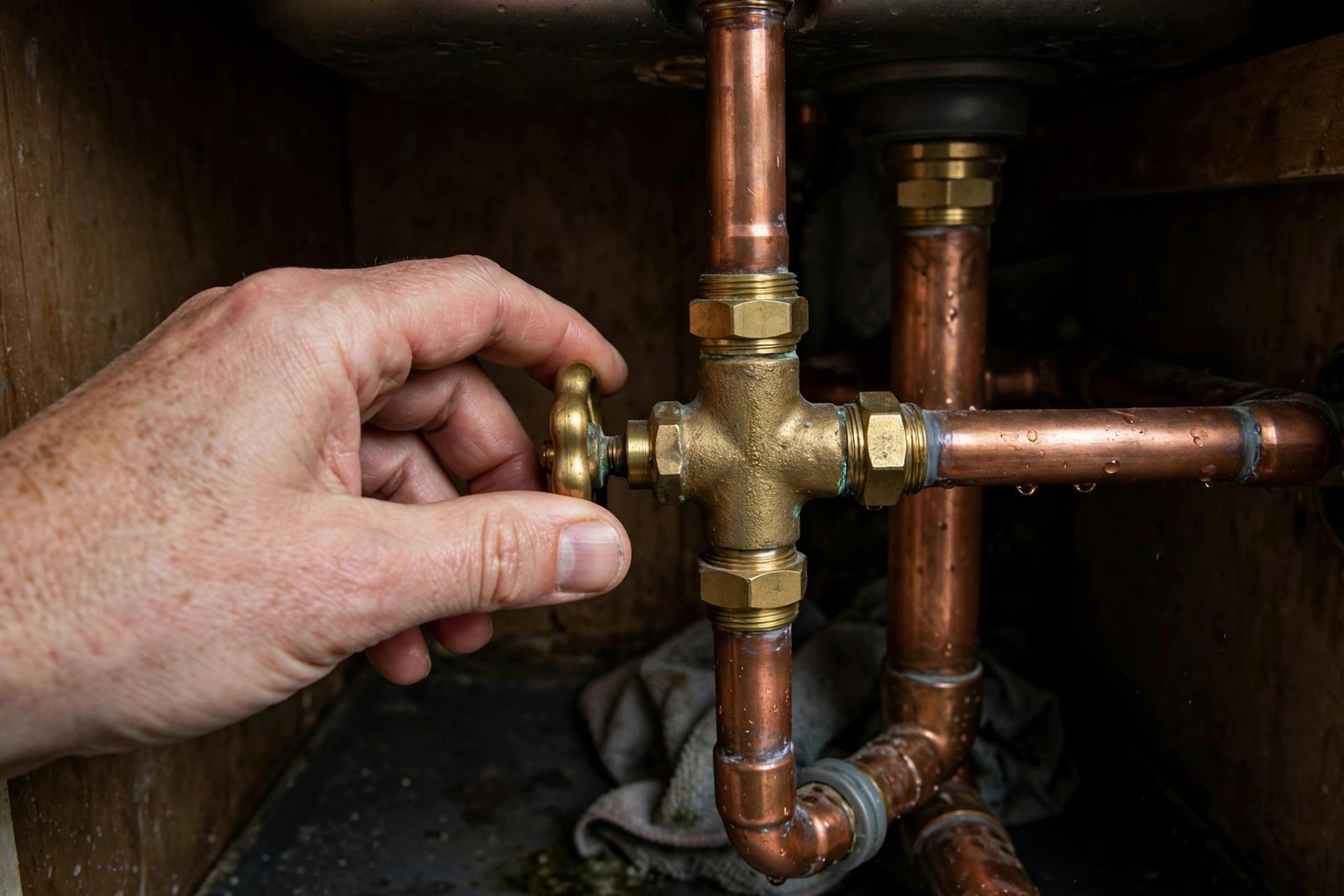
If a pipe bursts or a fitting fails, the water won’t stop until somebody stops it. Every minute of delay means more water through your floors and ceilings — so knowing how to turn off your water supply before you need to is one of the most useful things any homeowner can learn. It takes five minutes to find your stopcock on a calm Sunday afternoon, and it can save you thousands in water damage.
Finding Your Indoor Stopcock
Your indoor stopcock (also called a stop tap or stop valve) is the main on/off switch for all the water entering your home. In most Crawley homes, look in these places:
- Under the kitchen sink — the most common spot, often at the back of the cupboard
- In a hallway cupboard or under the stairs
- Near the front door, low down
- In the downstairs bathroom or utility room
- In flats, it may be in a communal cupboard on your floor, or in a service riser — check with your building manager if you can’t find it
It looks like a small brass tap or a lever on a pipe coming up through the floor. If you’ve just moved into a Crawley property — particularly one of the older Victorian terraces around the town centre or the post-war semis in Tilgate and Pound Hill — make finding the stopcock one of your first jobs.
How to Turn It Off
Once you’ve found it:
- Turn it clockwise until it stops — “righty-tighty.” A traditional wheel-type stopcock needs several full turns. A lever-type just needs a quarter turn so the lever sits across the pipe (perpendicular).
- Run a cold tap to check — the water should slow to a trickle and stop. If it doesn’t, the stopcock isn’t fully closed or it’s faulty.
- If the pipe you’re trying to isolate feeds the hot water cylinder or heating, switch off the boiler too, so it isn’t heating an empty system.
That’s it. You’ve just stopped the mains water to your entire home.
What If the Stopcock Is Seized?
This is extremely common. Stopcocks that haven’t been turned for years — or decades — seize solid. If yours won’t budge:
- Don’t force it with all your strength. Snapping an old stopcock can cause a flood worse than the one you’re trying to stop.
- Try a pair of grips or a wrench for extra leverage, gently.
- A squirt of WD-40 and ten minutes of patience sometimes frees a stiff valve.
- If it won’t move, call a plumber. A seized stopcock is a genuine problem — in an emergency you have no way to stop the water. We can free or replace it quickly; it’s a straightforward job.
And here’s a tip worth its weight in gold: turn your stopcock off and on once a year. It takes thirty seconds and keeps it working for the day you actually need it.
The Outside Stop Valve
If the indoor stopcock fails or you can’t find it, there’s a second option: the outside stop valve on your water supply pipe, usually under a small metal or plastic cover in the pavement, driveway, or front garden. It’s the property’s boundary valve and belongs to you up to that point (your water company owns the pipe before it).
You’ll typically need a long stopcock key to reach and turn it — not something most households own. In a genuine emergency, this is another reason to call a plumber fast rather than hunting around the street with a screwdriver. Note that on shared supplies (common in some older Crawley terraces), the outside valve may shut off a neighbour’s water too, so use it with care.
Draining the System After Shutting Off
Closing the stopcock stops new water coming in, but the pipes are still full. To drain them:
- Open the lowest cold tap in the house (often the garden tap or a downstairs sink) and let it run until it stops.
- Switch off the boiler, then open the hot taps to drain the hot water side.
- Flush the toilets — each cistern holds a flush or two of water.
Once drained, the system is depressurised and safe for a plumber to work on — and no more water can escape from a burst pipe.
Label It for the Whole Household
The best stopcock in the world is useless if nobody can find it. Once you’ve located yours:
- Stick a clear label on the cupboard door: “WATER STOPCOCK — turn clockwise to shut off.”
- Show everyone in the house where it is, including teenagers and regular guests.
- If you’re a landlord, this is worth adding to your tenant information pack — see our guide to landlord plumbing responsibilities.
Quick Recap
- Find your stopcock now — under the kitchen sink is the most likely spot.
- Turn it clockwise to shut off all water to the house.
- Test it once a year so it doesn’t seize.
- If it’s seized or missing, get it replaced before an emergency forces the issue.
Water emergencies are stressful enough without hunting for a valve you’ve never seen. Five minutes today can save you a ruined kitchen tomorrow. And if the worst does happen, our emergency plumbing guide explains what the repair will cost.
Stopcock seized, leaking, or missing? Plumb Buster can sort it — open 24 hours in Crawley, Horsham, Horley and East Grinstead. Call 07908 948654 for help now, or visit our services page and contact page to book a routine visit.