
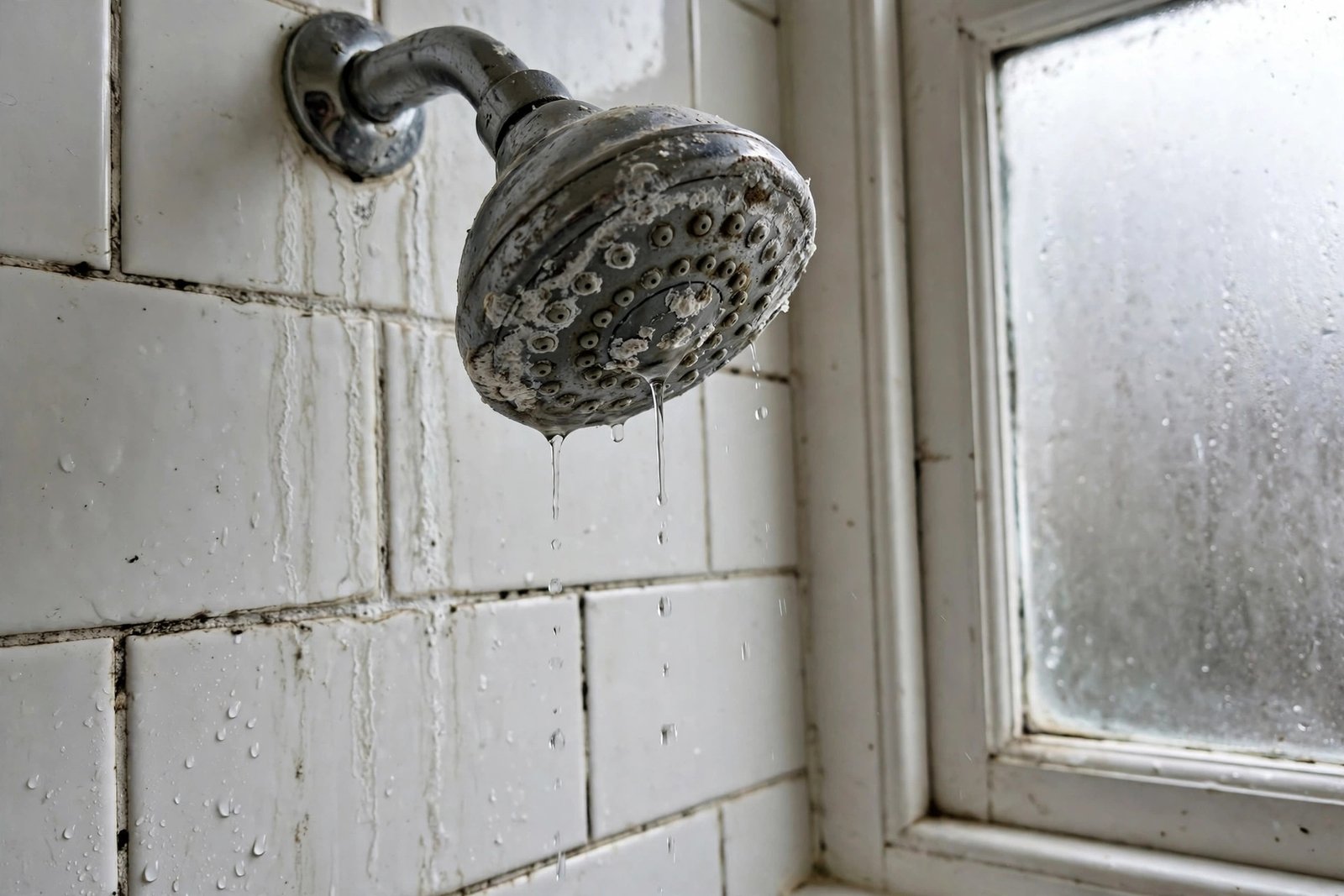
A shower that barely rinses shampoo out, taps that take an age to fill the sink, a cistern that refills at a trickle — low water pressure creeps up gradually, so you adapt without realising how bad it has got.
Most pressure problems have an identifiable cause and a fix. This guide covers the common causes in Crawley homes, the checks to run first, fixes that work, booster pump options and costs, and when to call a plumber.
What counts as normal pressure?
UK mains pressure typically sits between 1 and 3 bar, and suppliers should deliver at least around 1 bar at the boundary stopcock. Below that, showers go weak and upstairs taps suffer first, fighting gravity too.
Pressure is the force pushing water; flow is how much arrives. A furred-up pipe can start strong then fade to a dribble — a flow restriction, and the distinction matters for diagnosis.
The common causes of low water pressure
Limescale in aerators and showerheads
The most common cause in Crawley’s hard-water area. Tap aerators and showerheads clog with limescale until water barely gets through. Bad at one tap but fine elsewhere? This is almost certainly it — and the easiest fix.
A stopcock that is not fully open
After any plumbing work, a stopcock sometimes gets left half-closed — a quarter-turn short of fully open throttles the whole house. Always check this first; it costs nothing to fix.
Hidden leaks
Water escaping before it reaches your taps reduces pressure downstream. A gradual whole-house pressure drop plus a creeping water bill means suspect a leak — see spotting leaking pipes early.
Corroded or furred-up pipework
Old galvanised or copper pipework corrodes and scales internally over decades, narrowing the bore. Tell-tale sign: pressure worsening very slowly over years, worst on hot taps.
A faulty pressure reducing valve (PRV)
Some homes have a pressure reducing valve (PRV) protecting the pipework. When it fails it can stick half-closed and strangle the supply — a prime suspect if pressure dropped suddenly.
Shared or restricted supply
Older terraces sometimes share one supply pipe, so morning and evening peaks drop pressure for everyone. Old narrow pipes (lead or half-inch) simply cannot deliver modern flow rates.
Supplier-side issues
Roadworks, burst mains or maintenance in your street can drop pressure temporarily. If the problem appeared suddenly and your neighbours have it too, it is almost certainly the network, not your plumbing.
Quick checks before you spend money
Work through these in order — most pressure problems are solved by step 2 or 3:
- Check with neighbours. If they have the same problem, call your water supplier — it is their network. Check their website for reported works in your area first.
- Check your stopcocks. Find your internal stopcock (usually under the kitchen sink) and the external one at the boundary. Both should be fully open — turn anticlockwise until they stop. Our guide on how to turn off your water supply shows where to look.
- Clean the aerators. Unscrew the nozzle from the end of each affected tap, soak it in white vinegar or descaler for an hour, scrub with an old toothbrush and refit. Do the same with the showerhead — or soak it in a bag of vinegar tied over the head overnight.
- Check one tap vs all taps. One bad tap means a local blockage (aerator, tap filter or a kinked flexi hose). All taps bad means a supply-side issue.
- Check hot vs cold. Poor hot pressure but fine cold often points to the boiler, a scaled hot water cylinder coil or a failing mixer — not the mains.
- Look and listen for leaks. Damp patches, the sound of running water, a meter that moves when nothing is running.
Fixes that work
- Descale or replace aerators and showerheads — a few pounds each, and often transformative.
- Open stopcocks fully — free, and embarrassingly often the answer.
- Replace a faulty PRV — a plumber’s job, but straightforward.
- Powerflush or replace scaled pipework — for severely furred old pipes, replacement of the affected runs is the lasting fix.
- Fit an accumulator or booster pump — when the incoming mains simply cannot deliver enough (see below).
What does not work: “pressure boosting” showerheads help a little by aerating the spray, but they cannot create pressure that is not there. And never adjust or remove a PRV yourself to chase more pressure — it protects your pipework and appliances.
Booster pump options and costs
If the mains supply to your home is genuinely weak and the supplier cannot or will not improve it, a booster pump is the answer. The main options:
- Shower pump (single or twin impeller) — boosts one shower or the hot supply. Pumps start around £120 to £250 for the unit; fitted, expect £300 to £500 all in.
- Whole-house booster pump — pressurises the entire cold supply. Units run £200 to £500, with total installed costs typically £500 to £900 depending on access and pipework changes.
- Accumulator vessel — stores pressurised water and releases it on demand, giving strong flow without a pump running constantly. Quieter and excellent for combi-boiler homes, but pricier: £600 to £1,200+ installed.
Costs vary with the layout of your home and the pump specified, so treat these as realistic ranges rather than quotes. A plumber can test your actual pressure and flow and recommend the right option — oversizing a pump wastes money and can damage pipework.
When to call a plumber
Call a professional if:
- Pressure is low across the whole house and the stopcocks are fully open
- You suspect a hidden leak — pressure loss plus any sign of damp needs professional leak detection
- Hot water pressure is poor but cold is fine (possible cylinder, boiler or valve issue)
- You are considering a booster pump or accumulator — sizing and installation need to be right
- Pipework is old, corroded or undersized and needs replacing
- Pressure dropped suddenly with no obvious cause
A plumber with a pressure gauge can tell you in minutes whether the problem is your internal pipework or the supplier’s network — and that distinction decides who pays for the fix.
Do not put up with a dribble
Low water pressure is not something you have to live with. Most causes are simple — a scaled aerator, a half-closed stopcock — and even the serious ones, from hidden leaks to tired old pipework, have proper fixes.
If you have worked through the checks and the pressure is still poor, call Plumb Buster — Crawley’s local emergency plumber, open 24 hours a day and covering Crawley, Horsham, Horley and East Grinstead. Ring 07908 948654 any time for pressure diagnosis, leak detection and pump installations done properly, or get in touch online.