If your home pipes bang, clank, whistle or gurgle, you’re not imagining it — and it’s worth finding out why. Most noisy pipes have a straightforward cause, and many can be fixed in a single visit. Others are an early warning of something more serious, like a developing blockage or pipework under damaging pressure. Here’s how to tell the difference, what you can try yourself, and when it’s time to call a plumber.
The bang: water hammer
The most common cause of a loud bang or thud when you turn a tap off (or when a washing machine or dishwasher finishes filling) is called water hammer. It happens when flowing water is brought to a sudden stop and the shock wave has nowhere to go, so it slams through the pipework.
Water hammer is most likely when taps are shut off quickly, washing machines or dishwashers fill and stop abruptly, your water pressure is high (over about 3 bar makes hammering more violent), or pipework is poorly clipped.
A one-off knock is usually nothing to worry about. But repeated, violent banging is genuinely destructive: over months and years it can loosen joints, crack fittings, and eventually cause a leak behind a wall or under a floor.
How to fix water hammer
A few practical fixes, roughly in order of simplicity:
- Turn taps off more gently. With quarter-turn taps, close them with a slow, deliberate motion rather than a snap. This alone often tames mild hammering.
- Reduce your water pressure. If a plumber measures high mains pressure (common in Crawley homes on certain supplies), fitting a pressure-reducing valve where the mains enters the property brings everything down to a calmer level — typically around 3 bar.
- Fit water hammer arrestors. These are small shock-absorbing devices fitted near the offending valve or appliance (behind a washing machine is a classic spot). They contain a cushion of air that absorbs the shock wave. They’re inexpensive and a plumber can fit one in minutes.
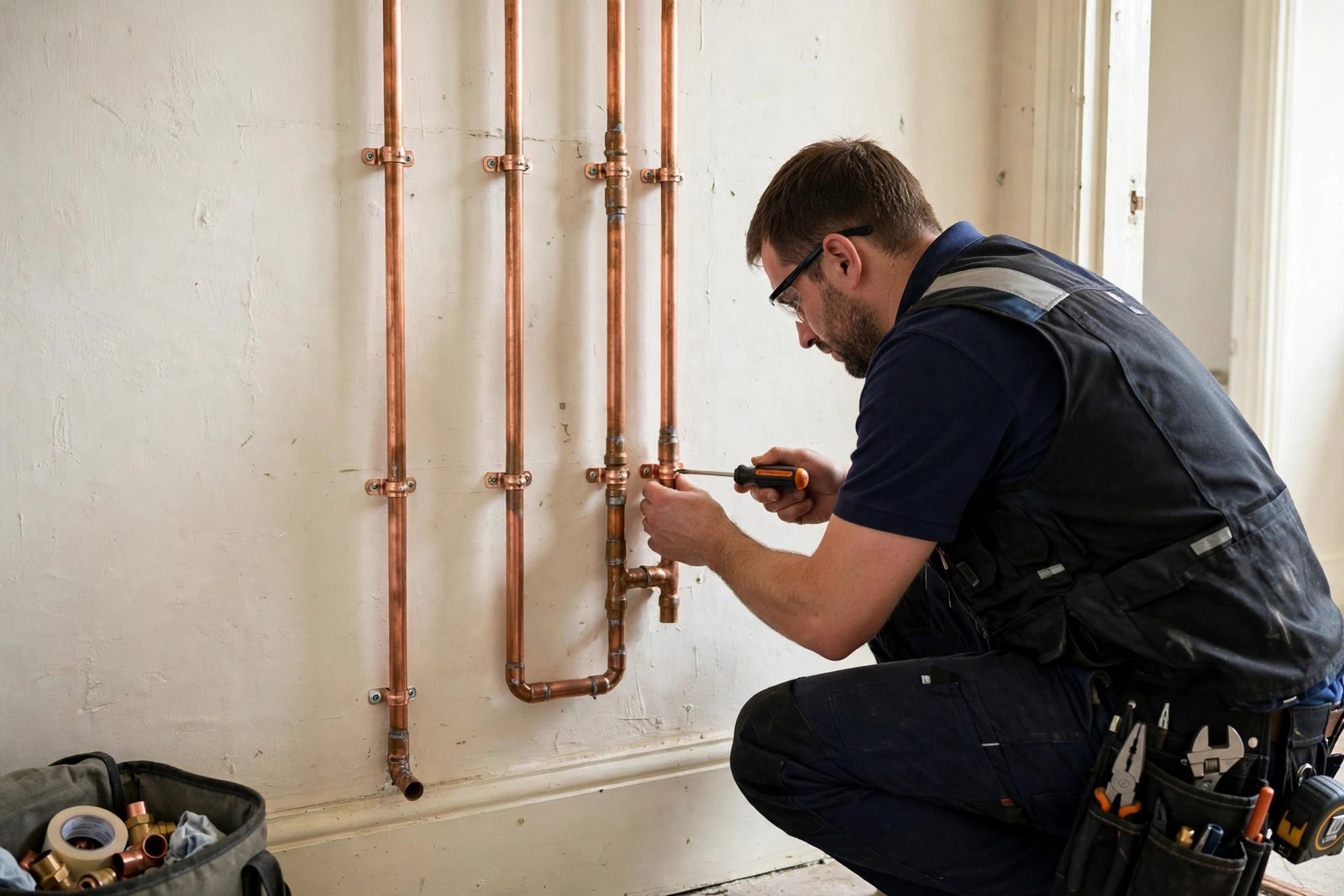
- Re-clip loose pipework. If pipes move visibly when they bang, they need more clips or better-positioned ones. This is a quick, cheap fix that stops a lot of noise.
If the banging is severe enough to shake pipes or rattle the whole run, don’t leave it — get it looked at before a joint gives way.
Loose or badly clipped pipework
Not every bang is water hammer. Pipes that were never clipped properly — or whose clips have perished over the years — can rattle, creak and knock as water flows through them, especially in heating systems. You’ll often hear this in the floor void or inside stud walls, and the noise usually matches the rhythm of the water flow rather than a single sharp thud.
The giveaway is location: if the noise clearly travels along a run of pipe, or you can feel the pipe moving where it’s exposed (in the airing cupboard, behind the washing machine), it’s a clipping job. A plumber can track the run and add proper clips at sensible intervals, plus lagging where pipes pass through joists so they can’t knock against timber. It’s a cheap fix that makes an immediate difference — especially if the pipes run under a bedroom.
Gurgling drains: usually a blockage warning
Gurgling sounds from sinks, baths or toilets — especially a “glug-glug” after water drains away — almost always mean air is being forced through the trap because the normal venting path is restricted. In plain English: there’s a partial blockage developing downstream.
This is one noise you shouldn’t ignore. A slow-draining sink that gurgles today can become a fully blocked drain tomorrow, and blockages that back up into a bath or toilet are deeply unpleasant to sort out at short notice. Watch for:
- Gurgling in the bathroom sink when the toilet is flushed (or vice versa)
- Water draining more slowly than it used to
- Bad smells alongside the gurgling
For a mild case, a plunger (used firmly, with the overflow sealed) can clear a partial blockage in a basin or bath waste. If the gurgling persists or affects more than one fixture, the blockage is further down the line and needs professional clearing. Our guide to blocked drains in Crawley explains what happens next.
Airlocks and hissing: trapped air in the system
A different family of noises comes from trapped air in heating pipework: ticking, clicking as pipes heat up and cool down, and a hissing or “kettling” sound from the boiler area. A little ticking as radiators warm up is normal — it’s just metal expanding. But loud hissing, constant gurgling in radiators, or radiators cold at the bottom while hissing at the top usually point to trapped air, limescale, or (in older systems) a failing pump.
Homeowner checks worth doing:
- Bleed your radiators. If the top is cold and it hisses when you open the bleed valve, trapped air is the culprit. Have a cloth ready and catch the first spurt of water. If radiators are cold at the bottom instead, that’s sludge rather than air — and needs a system flush by an engineer.
- Check boiler pressure. If it sits well below 1 bar, the system needs topping up — but if it keeps dropping, that’s a leak somewhere and worth investigating through our leak detection service.
When a noise means call a plumber
Call a plumber sooner rather than later if:
- The banging is violent enough to shake pipes or rattle walls — water hammer is damaging your pipework every time it fires
- Gurgling comes with slow drainage or smells — a partial blockage is forming
- You hear dripping or running water inside a wall or ceiling but can’t see it — that can be a hidden leak causing damage right now
- Noise started suddenly after plumbing work — something may have been left loose or misaligned
- The noise comes with low water pressure or discoloured water — worth getting the system checked sooner rather than later
If water is actively leaking from anywhere, treat it as an emergency: turn off your stopcock (usually under the kitchen sink) and call for emergency plumbing help.
What we’ll do about noisy pipes
When we visit, we start by identifying the noise type and tracing it to its source — the fix is completely different for water hammer, loose clipping, airlocks and partial blockages. Most noisy-pipe jobs are resolved in one visit: fitting arrestors or a pressure-reducing valve, re-clipping a run, clearing a partial blockage, or balancing a heating system. We’ll also check for damage the noise has already caused, like weeping joints, before it becomes a proper leak.
Need help with noisy pipes in Crawley?
Plumb Buster is a 24-hour emergency plumber covering Crawley, Horsham, Horley and East Grinstead. Whether your pipes bang when the washing machine fills, your drains gurgle every time you flush, or something’s started knocking in the wall at 2am, call us on 07908 948654 — any time. We’ll get to the bottom of it, and back to quiet.