How plumbers usually charge If you need a plumber, the first question is usually the price — and the honest answer is that it depends on the job. A dripping tap and a burst pipe are very different jobs, and the time of day matters too. This guide explains the typical costs you can expect from a plumber in Crawley in 2026, what affects the bill, and how to avoid overpaying. Important: the figures below are typical ranges only, not a quote. Every job is different, and the only reliable price is a clear, upfront quote for your specific job — given before any work starts. Most plumbers in Crawley charge in one of three ways: Hourly rate — you pay for the time on the job, plus parts. Common for repairs and diagnostics. Fixed price per job — a set price agreed before work starts. Common for standard jobs such as a tap replacement or a toilet repair. Call-out fee + hourly rate — a fee to attend, then an hourly rate on top. Common for emergency and out-of-hours call-outs. Always ask which structure applies before the work begins, and whether the quote includes VAT, parts, and parking or congestion costs. A reputable plumber will answer plainly. Typical hourly rates in Crawley As a rough guide only, a typical hourly rate for a plumber in the Crawley area often falls in the £60–£100 per hour range for standard daytime work. Rates vary with experience, the complexity of the job, and how busy local plumbers are. Out-of-hours work costs more. Evenings, weekends, and bank holidays typically attract a higher rate or an emergency call-out fee, because the plumber is attending outside normal working hours. If your job can safely wait until a weekday, it will usually cost less. Typical call-out fees A call-out fee covers the plumber’s time and travel to reach you and diagnose the problem. Typical ranges in Crawley are roughly: Standard daytime call-out: often around £50–£90, sometimes included in the job price or deducted from the final bill if you go ahead. Emergency / out-of-hours call-out: typically higher, often around £100–£200, depending on the time and the urgency. Ask upfront whether the call-out fee is separate or included, and whether it is refunded against the repair. That one question avoids most billing surprises. Typical prices for common jobs These are typical ranges only for straightforward jobs in Crawley. Your actual price depends on access, parts, the condition of the pipework, and how long the job takes. Dripping tap repair / tap replacement: £80–£180 Running toilet repair: £80–£170 Blocked toilet clearance: £90–£200 Blocked sink or drain clearance: £90–£220 Leak repair (accessible pipe): £90–£220 Radiator valve replacement: £90–£180 Boiler diagnosis + minor repair: £120–£350 (parts extra) Burst pipe repair: £150–£400+ (depends on damage and access) Jobs that involve lifting floors, opening walls, or replacing long pipe runs cost more, because the access work takes time. Water damage repair after a leak is a separate cost on top of the plumbing fix itself. What makes the price go up Several factors push a plumbing bill higher: Access. A leak under a tiled floor costs more to reach than a leak under a kitchen sink. Parts. A standard tap washer costs pennies; a thermostatic valve or a boiler PCB costs far more. Ask whether the quote includes parts and which parts are needed. Urgency. Same-day and out-of-hours attendance costs more than a booked weekday slot. Age and condition of the system. Older pipework, corroded fittings, and obsolete toilet cisterns take longer to work on and can need extra parts. Scope creep. A “small leak” can turn out to be a failed section of pipe. A good plumber stops, explains, and re-quotes before doing extra work. How to avoid overpaying Get a clear quote before work starts. If the plumber cannot quote, ask for an hourly rate, a maximum estimate, and a call before any extra work. Ask what is included. Labour, parts, VAT, call-out, and disposal should all be clear. Describe the problem accurately. Photos and a short description help the plumber quote more accurately and bring the right parts. Don’t ignore small problems. A dripping tap or a slow leak is cheap to fix now and expensive to fix after it damages a floor or a ceiling. Check reviews and guarantees. A plumber with a long track record of verified reviews and a clear guarantee is usually better value than the cheapest quote with no track record. Plumber cost vs. the cost of waiting Putting off a plumbing repair rarely saves money. A running toilet can waste hundreds of litres of water a day. A slow leak can rot floorboards, stain ceilings, and grow mould. A blocked drain can back up into the home. In almost every case, the early fix is the cheaper fix. Frequently asked questions How much does a plumber cost per hour in Crawley? As a rough guide only, a typical hourly rate in Crawley often falls in the £60–£100 range for standard daytime work. Out-of-hours and emergency rates are higher. Always confirm the rate before work starts. Do plumbers charge a call-out fee? Many do. A typical daytime call-out in Crawley is often around £50–£90; emergency call-outs are typically higher. Ask whether the call-out fee is included in the job price or deducted if you go ahead. What is the cheapest way to hire a plumber? Book a weekday slot instead of an emergency call-out where it is safe to wait, describe the problem clearly so the plumber brings the right parts, and get a clear quote before work starts. Fixing small problems early is almost always cheaper than waiting. Why do two plumbers quote different prices? Different charging structures (hourly vs. fixed price), different assumptions about access and parts, and different levels of experience. Ask each plumber what is included — labour, parts, VAT, and call-out — so you are comparing like with like. Should I get a fixed price or an hourly
How to Choose a Reliable Plumber in Crawley: 7 Checks Before You Book
When a pipe bursts at 2am or the boiler dies on a freezing morning, you don’t want to be scrolling through search results wondering who to trust. But even for planned work — a new bathroom, a boiler service, a leak that needs tracking down — choosing the right plumber makes the difference between a job done well and a costly mess. Here are seven checks to run before you book any plumber in Crawley. 1. Check their reviews — and where they come from Online reviews are the fastest way to separate good plumbers from bad ones, but not all review platforms are equal. Google reviews are a solid starting point: look for a high average rating and a decent number of reviews, and actually read a few — do customers mention punctuality, tidiness and fair pricing? Trade-specific platforms carry more weight because the reviews are tied to verified jobs. Checkatrade is the best-known in the UK, and a strong Checkatrade record — hundreds of reviews at a top score — is one of the most reliable signals there is. A plumber with 385 Checkatrade reviews at 10/10, like Plumb Buster’s 5.0 Google rating, has been vetted by hundreds of real customers across real jobs, not just a handful of friends leaving five stars. Be wary of plumbers with no reviews anywhere, or whose only reviews are anonymous testimonials on their own website. 2. Ask about qualifications Plumbing isn’t a protected trade in the UK — technically, anyone can call themselves a plumber. That makes qualifications one of the most important things to check. Look for membership of the Chartered Institute of Plumbing and Heating Engineering (CIPHE) or equivalent recognised qualifications such as NVQ Level 2/3 in plumbing. For anything involving gas — boilers, gas fires, gas pipework — the engineer must be on the Gas Safe Register. Always ask to see the Gas Safe card and check the registration number on the Gas Safe website; unregistered gas work is illegal and dangerous. For electrical work in bathrooms, the electrician needs to be qualified under Part P. A reputable firm will volunteer this information without being asked. 3. Confirm they’re insured A proper plumber carries public liability insurance — typically £1 million to £5 million of cover. This protects you if something goes wrong: a burst pipe during the work, water damage to your floors, or an accident in your home. Ask what cover they hold and don’t feel awkward about it. Legitimate tradespeople expect the question and answer it immediately. No insurance — or vague answers about it — is a dealbreaker. 4. Demand transparent pricing and written quotes Nobody likes pricing surprises. For planned work, get a written quote before the job starts, ideally from two or three plumbers so you can compare like for like. A proper quote breaks down labour and materials separately and states what’s included — and what’s not. For emergency work, you can’t always get three quotes at 2am, but you should still get a clear price before work begins. Ask: What’s the call-out charge, and does it include the first hour? Is there an out-of-hours surcharge, and how much? Are parts charged at cost, and will I see the breakdown? Be cautious of plumbers who won’t discuss price until after the work is done, or whose “quote” is a vague verbal figure. Written, itemised and agreed in advance is the standard you should hold every plumber to. 5. Look for guarantees on the work A confident plumber stands behind their work. Ask how long they guarantee labour for — 12 months is a reasonable minimum on installation work. Parts should carry the manufacturer’s warranty on top of that. Get the guarantee in writing on the invoice. If a plumber won’t put their guarantee in writing, ask yourself why. 6. Choose local — and check response time A genuinely local plumber has real advantages. They can get to you quickly in an emergency — crucial when water is pouring through your ceiling. They know the area’s housing stock: the Victorian terraces near Crawley town centre, the 70s estates in Broadfield and Bewbush, the newer builds around Maidenbower all have their quirks, and a local engineer has seen them all. Check that the plumber actually operates where you are. A mobile number and a Crawley address is a good sign; a plumber “covering the South East” from two counties away may take hours to reach you when it matters. And for emergencies, 24-hour availability matters — a burst pipe doesn’t wait for office hours. 7. Watch for red flags Some warning signs should stop you booking immediately: Cash only, no invoice. Legitimate businesses take bank transfer and card, and always provide an invoice. No fixed address. A plumber with no business address and only a mobile number is hard to find if something goes wrong. Pressure to decide now. “This price is only good if you agree today” is a sales tactic, not a sign of demand. No ID, no branding. Unmarked van, no uniform, no business cards — small things, but they add up to a picture of how the business is run. Asking for large deposits upfront. A modest deposit for materials on a big job is normal; demanding half or more before any work starts is not. Dodging the insurance question. See check 3. Trust your instincts. If something feels off during the first conversation, it usually is. How Plumb Buster measures up We hold ourselves to exactly the standards above, because they’re the standards we’d want from anyone working in our own homes: Reviews: 5.0 rating on Google, plus 385 Checkatrade reviews at 10/10 from real customers. Local and fast: based in Crawley, covering Crawley, Horsham, Horley and East Grinstead, with rapid emergency response. Always open: we’re open 24 hours a day, every day — emergencies don’t keep office hours, so neither do we. Transparent pricing: clear pricing agreed before work starts, written quotes for planned work, and
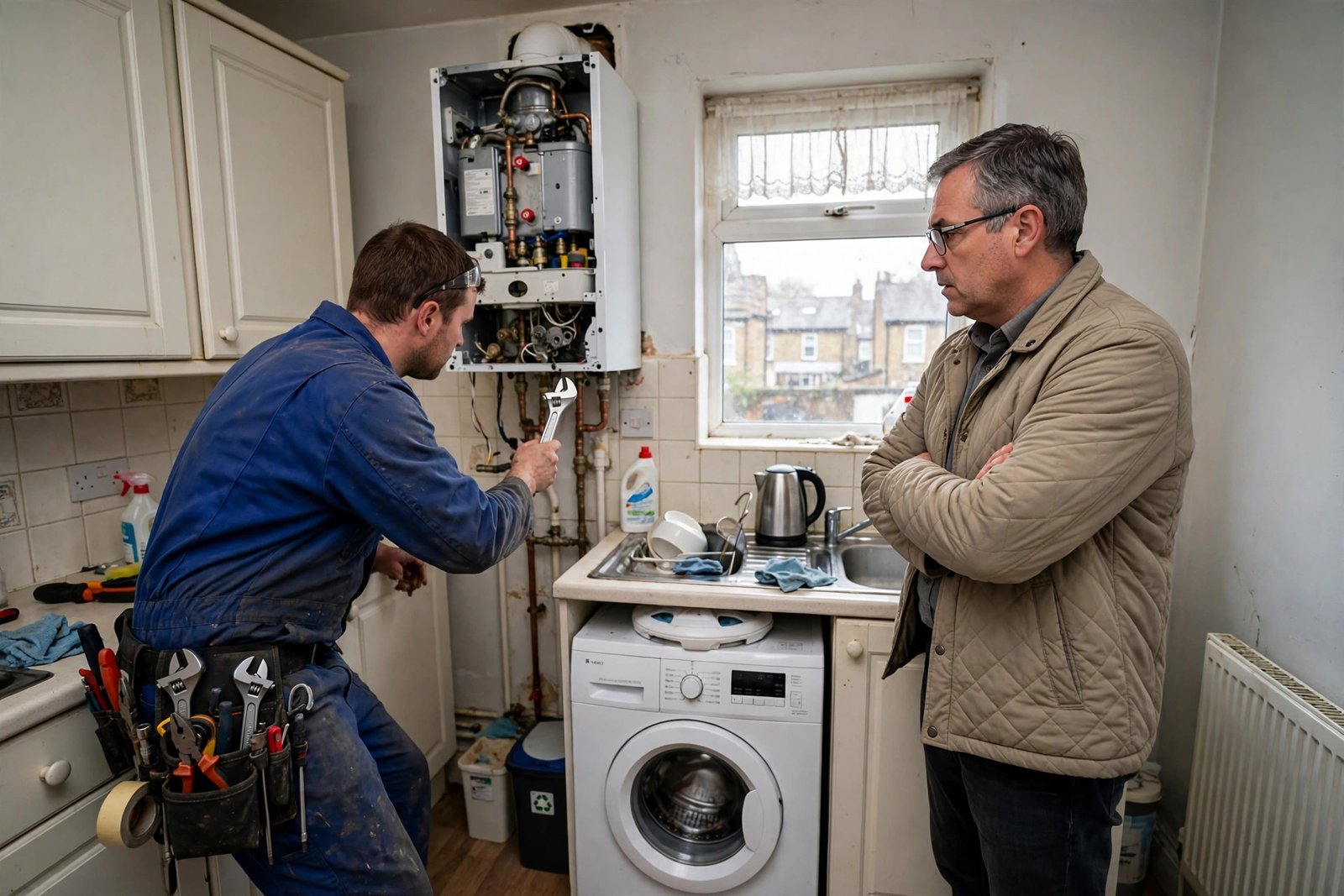
Landlord Plumbing Responsibilities in the UK: A Simple Guide
If you rent out property in Crawley — whether it’s a single flat near the town centre or a small portfolio across West Sussex — plumbing responsibilities are one of the areas where getting it wrong gets expensive. Tenants have strong legal protections, and the line between “landlord’s problem” and “tenant’s problem” isn’t always where landlords expect it to be. This guide covers the essentials in plain English. (It’s general information, not legal advice — for complex disputes, speak to a solicitor or your letting agent.) The basic rule: structure and systems vs misuse Under Section 11 of the Landlord and Tenant Act 1985, landlords are responsible for keeping in repair: The structure and exterior of the property The installations for the supply of water, gas and electricity — which includes pipework, water tanks, boilers and radiators Sanitation installations — basins, sinks, baths, toilets and the pipework serving them In practice, this means the plumbing system itself is your responsibility: pipes, the boiler, radiators, the hot water cylinder, taps, toilets, baths and sinks, and the drains serving the property. If a pipe bursts, the boiler breaks down, the toilet stops flushing, or a tap fails through wear and tear, that’s on you. The tenant’s responsibility is narrower: using the property properly and not causing damage. If a tenant blocks the toilet by flushing something they shouldn’t, or breaks a tap through misuse, the cost of putting it right can fall to them. But the default position — and the one the courts take — is that the landlord maintains the systems. “The tenant should have reported it sooner” doesn’t transfer a repair duty to them. Important: your tenancy agreement can add to your obligations, but it can’t take away the Section 11 duties. Any clause claiming the tenant is responsible for plumbing repairs is unenforceable. Gas safety: non-negotiable If the property has gas, you must: Have all gas appliances, pipework and flues safety-checked every 12 months by a Gas Safe registered engineer Give the tenant a copy of the gas safety certificate (CP12) within 28 days of the check, or before they move in for new tenancies Keep records of each check for at least two years There is no grace period and no exemption for “the boiler was fine last year”. Failing to hold a valid gas safety certificate is a criminal offence, can invalidate a Section 21 eviction, and — most importantly — puts lives at risk. Carbon monoxide from a faulty boiler kills. Book the annual check before the certificate expires, not after. If you’re unsure whether your boiler is showing warning signs between services, our guide to boiler warning signs explains what to watch for. Responding to repairs: what “reasonable time” means The law says repairs must be done within a “reasonable” time, and what counts as reasonable depends on the severity: Emergencies — burst pipes, major leaks, no hot water or heating in winter, sewage backing up — need a response within 24 hours, and often the same day. A burst pipe flooding a flat can’t wait until Monday. Urgent but not dangerous — a broken toilet (where there’s only one), a significant leak — within a few days. Routine — a dripping tap, a slow drain — within a couple of weeks is generally acceptable. Tenants must give you access to carry out repairs, but you must give at least 24 hours’ written notice except in genuine emergencies. And if you fail to act, tenants can report you to the council’s environmental health team, arrange the repair themselves and bill you, or in serious cases claim compensation. For Crawley landlords, the practical lesson is simple: have a reliable plumber on speed dial before the emergency happens. When a tenant calls at 11pm about water coming through the ceiling, you don’t want to be comparing quotes. HMOs: extra duties If you operate a House in Multiple Occupation (HMO) in Crawley — three or more tenants from more than one household sharing facilities — additional rules apply. HMOs need a licence from Crawley Borough Council, and the management regulations impose specific duties on plumbing and sanitation: Adequate numbers of bathrooms, toilets and washbasins for the number of occupants Hot and cold water supplies maintained in good working order Drainage kept clear and in repair More frequent inspection expectations, since shared facilities wear faster HMO plumbing takes heavier use than a single-let, so preventative maintenance — regular checks on shared bathrooms, prompt attention to slow drains — pays for itself many times over. Keep records of everything Good record-keeping is one of the cheapest forms of protection a landlord has. Keep: Gas safety certificates for every year of the tenancy (minimum two years) Invoices and reports for all plumbing and heating repairs Records of when issues were reported and when they were fixed Boiler service history If a deposit dispute or disrepair claim ever arises, this paper trail is your evidence that you acted promptly and properly. Ask your plumber for itemised invoices on every job — a professional will provide them as standard. How a reliable local plumber keeps landlords compliant The landlords who sleep well at night have one thing in common: a trusted local plumber they can call for everything from annual boiler services to 2am emergencies. What that relationship gives you: Annual servicing scheduled for you — gas safety certificates and boiler services booked before they expire, so compliance never lapses. Fast emergency response — a burst pipe or heating failure dealt with within hours, protecting your property and keeping you on the right side of “reasonable time”. Familiarity with your properties — an engineer who knows your boiler, your pipework and your properties’ quirks diagnoses problems faster. Proper documentation — itemised invoices and service reports that build your compliance paper trail automatically. Honest advice on big decisions — like whether that 15-year-old boiler should be repaired again or replaced before it fails mid-tenancy. Our guide on when to call an emergency