
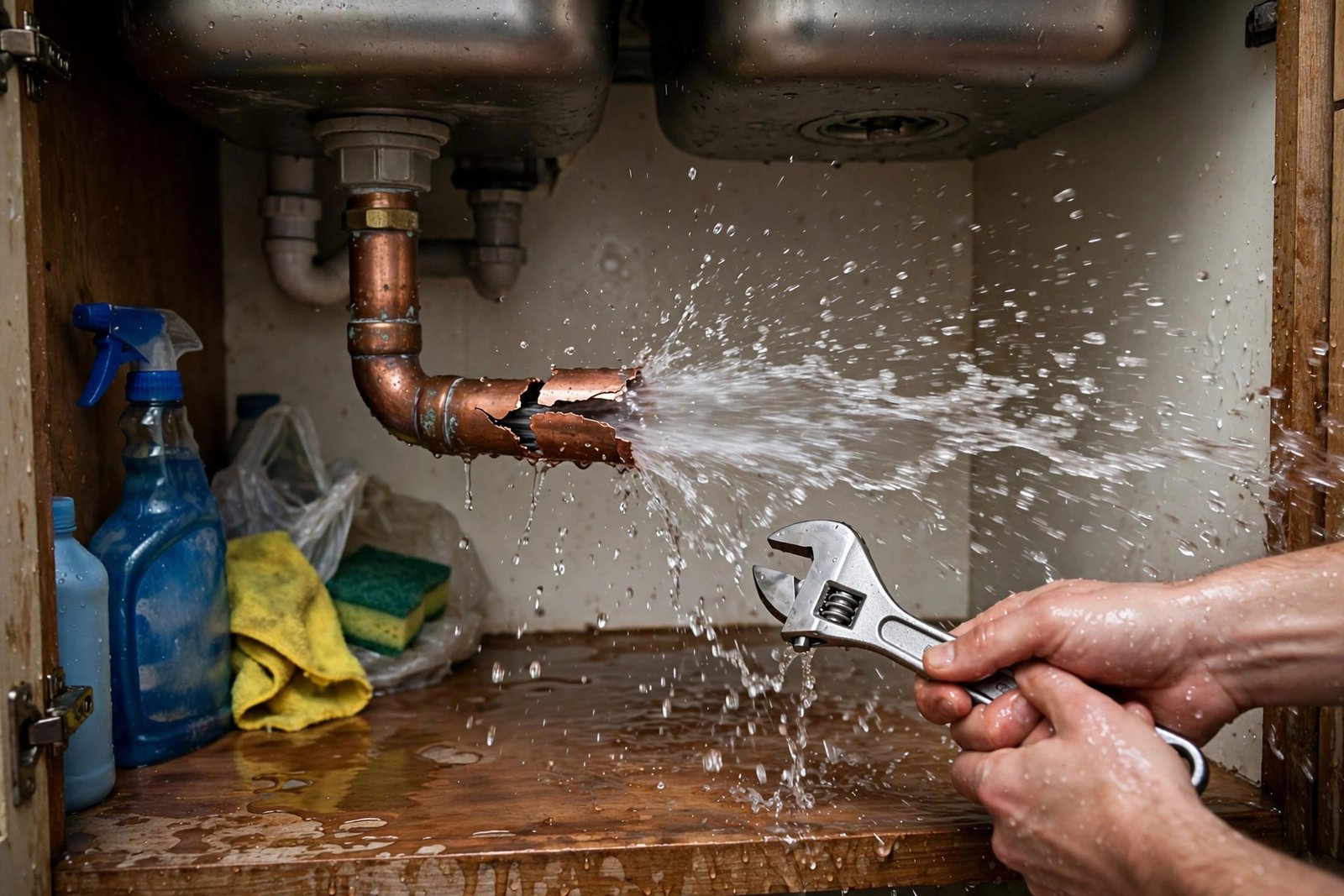
A burst pipe can release hundreds of litres of water into your home in a matter of minutes. The damage gets worse with every minute the water keeps flowing, so the first thing you do matters far more than how fast the plumber drives. Follow these seven steps in order, then call for help.
Step 1: Shut Off the Water at the Stopcock
This is the single most important thing you can do. Find your indoor stopcock and turn it clockwise until it’s fully closed. In most Crawley homes it’s under the kitchen sink, in a hallway cupboard, or under the stairs. Closing it stops the flow to the burst section and turns a disaster into a manageable repair.
If you don’t know where yours is, read our guide on how to turn off your water supply — find it today, not during a flood.
Step 2: Switch Off the Electrics if Water Is Near Sockets or Switches
Water and electricity are a lethal combination. If water is running near plug sockets, light switches, or the consumer unit, switch off the power at the fuse box immediately. Do not touch any electrical fittings with wet hands, and don’t stand in pooled water while switching anything off — if it’s not safe to reach the fuse box, get out and call for help.
Step 3: Drain the Remaining Water from the Pipes
Once the stopcock is closed, open all the cold taps (starting with the lowest one in the house, usually a garden tap or downstairs sink) to drain the water still sitting in the pipes. Then switch off the boiler and open the hot taps to drain the hot water system too. This stops water continuing to spill from the burst and relieves pressure elsewhere in the system.
Step 4: Contain the Water
Grab towels, buckets, mops — whatever you have. Push towels around the base of doors to stop water spreading into other rooms, and put buckets under active drips. If water is coming through a ceiling, move furniture and valuables out from underneath. Poke a small hole in a bulging ceiling with a screwdriver to let the trapped water drain into a bucket in a controlled way — a collapsed ceiling does far more damage than a neat hole.
Step 5: Move Valuables and Protect Belongings
Get rugs, electronics, documents, and anything irreplaceable off the floor and away from the affected area. Lift the bottom of curtains if water is spreading across the floor. If there’s time, roll back carpet from the edges of the wet area — wet carpet can often be saved if it’s lifted and dried quickly, but soaked underlay usually needs replacing.
Step 6: Document the Damage for Your Insurance
Before you start clearing up in earnest, take photos and a short video of everything: the burst pipe itself, the water, and any damaged belongings, walls, floors, and ceilings. Insurers want evidence of the cause and the extent of the damage. Note the time you discovered the leak and what you did. Most home insurance policies cover the damage caused by burst pipes (though not always the cost of the pipe repair itself), and good documentation makes the claim far smoother.
Step 7: Call a 24-Hour Plumber
With the water stopped and the damage contained, call a professional. When you ring, be ready to tell them: where the burst is, whether you’ve isolated the water, whether any electrics are affected, and whether the ceiling or walls are damaged. That lets them bring the right parts and give you an accurate arrival time.
If you’re in Crawley, Horsham, Horley or East Grinstead, Plumb Buster’s emergency plumbing team is available around the clock — call 07908 948654 and we’ll talk you through it while we’re on our way.
What NOT to Do
- Don’t try to solder or repair a burst pipe yourself while the system is pressurised. You won’t fix it and you’ll lose time.
- Don’t use electrical appliances in wet areas until everything is dry and checked.
- Don’t ignore a “small” burst. Even a pinhole leak in a pressurised pipe can cause serious damage behind walls and under floors over hours. If you suspect a hidden leak, our leak detection service can find it before it gets worse.
- Don’t turn the heating back on until the plumber has checked the system — heating an empty or damaged system can cause further problems.
Temporary Fixes That Can Slow the Flow
If the stopcock won’t close fully and you’re waiting for the plumber, a few stopgap measures can reduce the flow. Wrap the burst tightly with several layers of electrical tape or a purpose-made pipe repair clamp if you have one, and wedge a piece of rubber (an old inner tube or a section of garden hose split lengthways) under the tape for a better seal. These are strictly temporary — they slow the leak, they don’t fix it — but they can buy you valuable time and limit damage while help is on the way.
How Burst Pipes Happen (and How to Prevent the Next One)
Most bursts in Crawley happen in winter when water freezes and expands inside uninsulated pipes — lofts, garages, and outside walls are the usual suspects. Read our guides on how to prevent and thaw frozen pipes and the winter plumbing checklist to cut your risk. The typical cost of emergency plumbing is also worth knowing before you ever need it.
Pipe burst in Crawley? Act fast, then call Plumb Buster — open 24 hours, 07908 948654. Our emergency plumbers cover Crawley, Horsham, Horley and East Grinstead, day and night. See who we are or get in touch to book a non-urgent visit.