
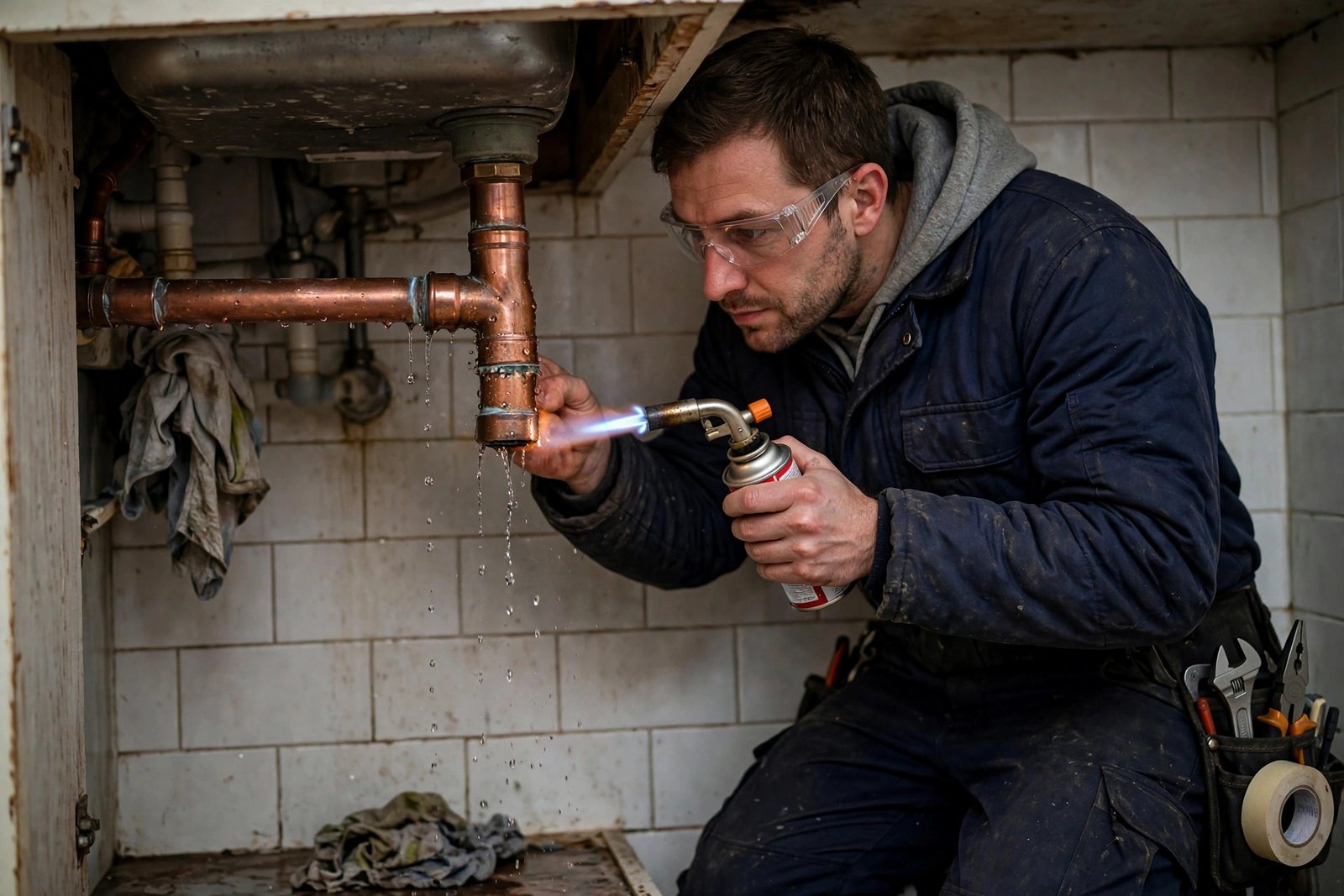
A leaking pipe rarely announces itself. Unlike a burst pipe — dramatic, obvious, impossible to ignore — a slow leak can run for weeks or months behind a wall, under a floor or inside a cupboard, quietly soaking timber, plaster and insulation. By the time most people notice, the repair bill has grown from a simple pipe fix into damp treatment, redecoration or new flooring.
The good news: leaking pipes almost always leave clues. This guide covers the early warning signs, where leaks like to hide, what to do the moment you suspect one, temporary fixes that buy you time, and when to call in professional leak detection.
Early warning signs of a leaking pipe
Watch for these — any one of them is worth investigating:
- Damp patches on walls, ceilings or floors that were not there before, especially ones that grow or darken
- A musty or earthy smell in a room, cupboard or hallway with no obvious source
- Mould growth, particularly black mould appearing on walls or skirting boards
- A water bill that has crept up with no change in your usage — a classic sign of a hidden leak
- The sound of running water when no taps are on, especially at night
- Low water pressure at taps or in the shower that has developed gradually
- Warped, lifting or stained flooring — laminate and wood floors react quickly to moisture from below
- Flaking paint or bubbling wallpaper
- Your boiler losing pressure repeatedly with no visible leak (the leak may be on the heating circuit)
A single sign might have another explanation, but two or more together should be treated as a leak until proven otherwise.
Where leaking pipes hide
Leaks happen at joints, bends and anywhere pipes have been stressed — and the worst ones are the ones you cannot see:
- Under sinks and basins — supply connections and waste traps work loose over time; check inside cupboards with a torch
- Behind baths and shower enclosures — pipework boxed in during a bathroom refit is a classic hiding place
- Under floorboards and in ceiling voids — central heating pipes and hot water runs live here
- Inside walls — particularly where pipes pass through masonry or under windows
- In the loft — header tanks, overflow pipes and exposed runs are vulnerable, especially after cold snaps
- Outside — the supply pipe between your boundary and the house can leak underground, showing up as a soggy patch in the garden or an unexplained damp cellar
In Crawley’s older terraces, original pipework can be decades old, with compression joints that have slowly worked loose. In newer estates, leaks more often come from push-fit joints that were never fully seated or pipes nicked during other building work.
What to do the moment you suspect a leak
- Turn off the water. If you can see or hear an active leak, shut off the mains stopcock straight away — our guide on how to turn off your water supply shows you where to look. For a heating-circuit leak, switch the boiler off too.
- Contain the water. Buckets, towels and bowls under the drip; move furniture, rugs and electrics away from the wet area.
- Take photos. Document damp patches, staining and any visible leak — useful for insurance and for the plumber.
- Check your water meter. Note the reading, avoid using any water for an hour or two, then check again. If it has moved, water is escaping somewhere.
- Do not ignore it. A small leak never stays small. Water finds its way into joists, insulation and electrics, and the longer it runs the more damage it does.
If the leak is major — water pouring through a ceiling or flooding a room — treat it as an emergency: turn off the water and call our emergency plumbing line immediately.
Temporary fixes that buy you time
These will slow or stop a small leak until a plumber arrives — they are not permanent repairs:
- Epoxy putty — knead the two-part putty, press it firmly over the leak on a dry-as-possible pipe, and let it cure. Good for pinholes and weeping joints on copper and plastic.
- Self-amalgamating repair tape — stretch it tightly around the pipe, overlapping each turn by half. It fuses into a watertight band. Works best on straight runs.
- A pipe repair clamp — a metal sleeve with a rubber lining that bolts around the pipe. The most robust temporary fix, available at DIY shops.
- Tightening a compression joint — if the leak is a slow weep from a compression fitting, a quarter-turn with a spanner sometimes reseats it. Do not overtighten — you will make it worse.
Keep the water pressure low while a temporary fix is in place, and check it regularly. None of these survive indefinitely, especially on hot pipes.
When to call for professional leak detection
Call a plumber with proper leak detection equipment when:
- You have the signs of a leak but cannot find the source
- The leak is behind a wall, under a floor or underground
- A temporary fix is not holding, or the leak keeps returning
- Your water bill or boiler pressure keeps dropping with no visible cause
- You need to know exactly where the leak is before lifting floors or chasing walls
Professional leak detection uses acoustic listening equipment, thermal imaging cameras and moisture meters to pinpoint leaks without tearing the house apart. Finding the exact spot first means less damage, less mess and a cheaper repair. It is the difference between lifting one floorboard and lifting the whole floor.
A note on insurance: “trace and access”
Many UK home insurance policies include “trace and access” cover, which pays for the cost of finding a leak (lifting floors, removing panels) as well as repairing the damage it caused — though not always the pipe repair itself. Check your policy before work starts, and keep photos and receipts. A plumber’s written report on the leak’s location and cause strengthens any claim.
Do not let a small leak become a big bill
Water damage is one of the most expensive home repairs precisely because leaks go unnoticed for so long. The earlier you catch it, the simpler the fix — often just a joint, a section of pipe, or a reseated fitting.
If you suspect a leaking pipe anywhere in your Crawley, Horsham, Horley or East Grinstead home, call Plumb Buster on 07908 948654. Our 24-hour service offers professional leak detection and leaking pipe repair — we will find the leak, fix it properly and help limit the damage. If water is pouring where it should not be, do not wait: our emergency plumbing service is open around the clock.